
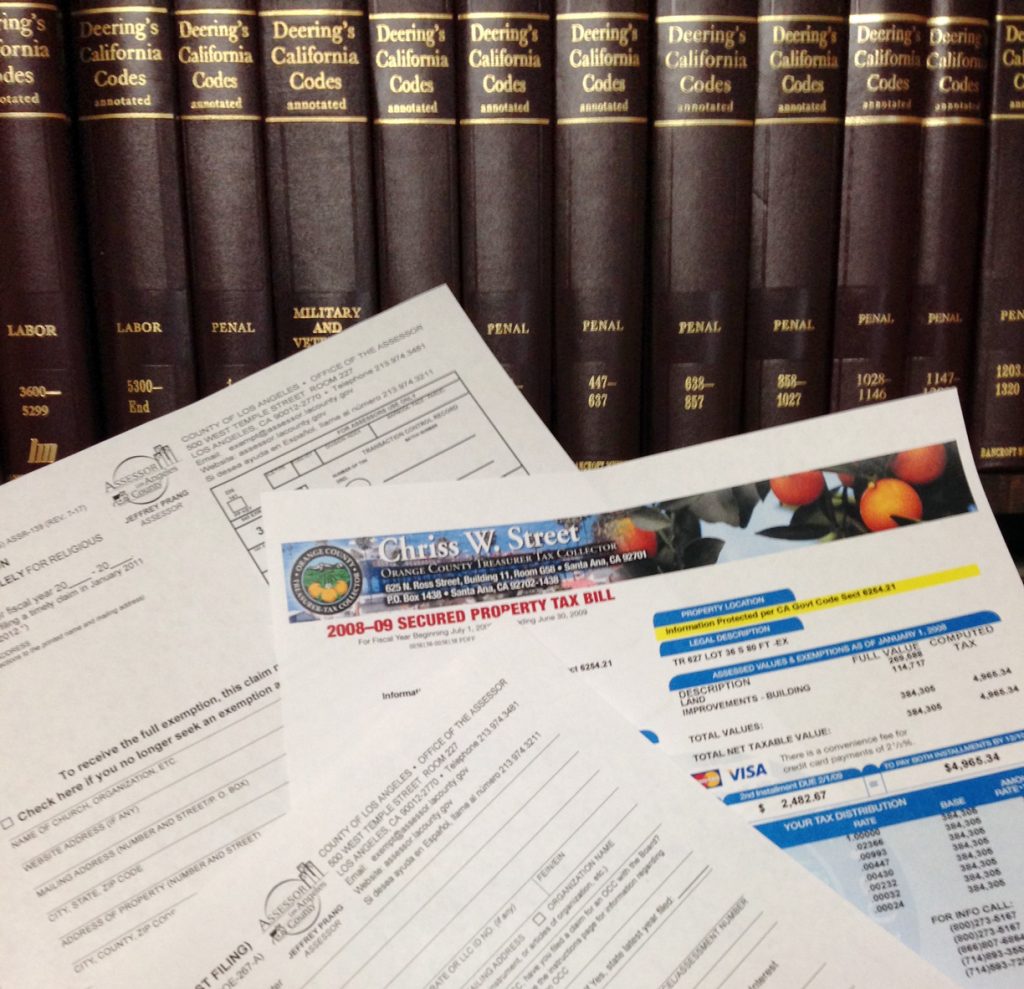
Church property tax exemptions are under increasing pressure as counties throughout California look to churches as a way of increasing their revenue. One way to do so is by revoking all or part of an organization’s exemption. Generally speaking, once a property has been classified as exempt, there is no specific guarantee the organization will continue to be exempt from the general tax levy against their property.
Church Property Tax Exemptions: An Overview
Churches are not exempt from special assessments, but only from taxes. Taxes are imposed on both real and personal property; with very few exceptions, special assessments apply only to land or to land and improvements. Church property remains subject to all district levies on land only or land and improvements only.
Thus an organization granted an exemption, direct benefit tax assessments and levies remain payable against the property. Those amounts are usually minor (but not always) and are not included in this article.
Church property tax exemptions are governed by state law, addressed in the California State Constitution and Revenue and Taxation Code sections 214–215. No property owned by an exempt organization automatically qualifies for church property tax exemptions — classification must be applied for and, in most cases, maintained by annually filing throughout the term of ownership. The type of exemption that may be claimed is determined by the manner in which the exempt organization utilizes the property, as set forth by the State Board of Equalization.
Church Exemption
This exemption is only available to a religious organization that uses its property exclusively for religious worship as of the January 1st property tax lien date, and usually extends to the property the church owns and uses for parking (sometimes with exception). The State considers typical church activities that qualify property for the church exemption to include:
- Regularly scheduled worship services with attendance and participation of the complete congregation.
- Sacramental activities such as baptisms, confirmations, Bar and Bat Mitzvahs, weddings, and funerals.
- Incidental and necessary uses of the property that support the primary religious worship use, such as administration, business meetings of the church governing body, religious instructional sessions, choir practice, and most activities of auxiliary organizations that answer to the local church authority.
- Sales of religious material to people attending worship services or from a church-operated reading room located on the same property as the church.
- Property owned by the church and needed to park the vehicles of those who attend or participate in religious worship, provided that fees charged for parking do not exceed costs of operation and maintenance (again, sometimes with exception).
- Property leased to the church and needed to park the vehicles of those who attend or participate in religious worship, when certain conditions are met.
In addition, this classification would apply when other organizations utilize the property, provided it is an incidental use by another nonprofit organization or where the property is used by another religious organization. It should be noted that said incidental use may not interfere with the use of the property for religious worship, and that the user may not be charged for their use beyond ordinary and necessary expenses for making the facility available for that use.
The exemption must be filed annually.
Religious Exemption
This exemption is available for property owned by a church that uses their property provided it conducts worship services on the property, or holds worship services and operates a school on the same property. These schools do not usually include preschools or nursery schools, but can include kindergartens, elementary schools, secondary schools, or any combination thereof, but is not available if the only school on the property is a college-level school, unless the college-level school is conducted in conjunction with a school of less than college level on the property.
This exemption is also available for property owned and operated by a church when used for religious worship and school purposes, when the church allows another religious organization to use their property for part-time religious worship, operate one of the specified schools stated above, or a combination thereof.
Church-owned properties that are not used for religious worship may also be eligible for a religious exemption, but not in all cases. These types of property may include property owned by the church and needed for church parking, property leased to a public school for public school purposes, provided the church files an annual Lessors’ Exemption Claim form, and property acquired on or after the January 1 lien date provided certain conditions are met.
The California Board of Equalization specifically cautions property owners that church property tax exemptions can be disqualified by improper third-party use — so before allowing another organization to use your property, you should first determine whether the proposed use will disqualify the property from the religious exemption. If the use of a church property by an unrelated nonprofit organization does not meet the conditions set forth by the Board of Equalization, the property would not be eligible for the religious exemption.
Welfare Exemption
This exemption is available for property owned by a religious organization that uses the property exclusively for religious purposes, including worship and school activities. This exemption will most often come into play when a church is allowing another organization to operate on their property, but only if both the owner and operator are eligible organizations and both file and qualify for the welfare exemption. This scenario will most often come into play where the operator is a public charter school or other nonprofit organization. In addition, that operator’s use of the church property must be incidental to the church owner’s primary activities such as religious worship, and one of the following applies:
- The user organization qualifies for the welfare exemption and the organization files for and receives the exemption.
- The user organization is a public school or an exempt government entity that uses the property for an activity that would qualify for the exemption if carried out by the property owner. The property owner must file a copy of the lease agreement with the exemption claim form.
- The user organization holds meetings on the property and all of the following apply: the meetings are incidental to the organization’s primary activities; the meetings are not fundraising meetings or activities (the direct solicitation of money, property, or goods); the meetings are not held more than once a week; the user organization qualifies as a tax-exempt organization under Internal Revenue Code section 501(c)(3) or 501(c)(4) or California Revenue and Taxation Code section 23701d or 23701f; and the user organization and its use of the property meet all the legal requirements found in Revenue and Taxation Code section 214, subdivision (a), paragraphs (1) through (5).
Under the welfare exemption path to church property tax exemptions, the Board of Equalization first determines whether an organization is eligible, and then the county tax assessor determines whether the property itself qualifies. Obtaining an Organizational Clearance Certificate with the Board of Equalization is a multi-tiered process requiring an annual filing and is beyond the scope of this article.
Related Articles
The Risks of Renting Out Your Church Parsonage in California
Parsonage Property Tax Exemption in California
Church Officer and Director Liability
Cell Towers at Churches
Disclaimer: Every situation is different and particular facts may vary, thereby changing or altering a possible course of action or conclusion. The information contained herein is intended to be general in nature, as laws vary between federal, state, counties, and municipalities and therefore may not apply to any given matter. This information is not intended to be legal advice or relied upon as a legal opinion, course of action, accounting, tax, or other professional service. You should consult the proper legal or professional advisor knowledgeable in the area that pertains to your particular situation.

